The 65-in-1 kit was one of my treasured childhood experiences (circa 1974). I ended up with a degree in electrical engineering, though I was probably on that path anyway.
The highlight was when I was futzing with a slow oscillator and accidentally discovered that using using the speaker transformer as a voltage step up I could get the inductive voltage spike when the relay switched to give a painful shock.
I wrote down that wiring diagram so I wouldn't lose it. One of my brothers had built a 9V variable power supply in a high school shop class, so we made use of that to create a pain game: hold the two leads and turn up the 9V supply output until you gave up. Whoever got the voltage knob the highest won. Our arm muscles would be involuntarily twitching, like a TENS unit.
The other game was one person would hide it in the house somewhere, say a closet, and the other person would use an AM radio to locate it, as the spike would release broadband RF energy which could be picked up by the radio. The closer one was the louder the clicking would come out of the speaker.
Oh, boy, I had that 65-in-1 set too. It was transformative and is why I'm a dev now, in an indirect way. That kit made me interested in electronics, which got me to take a digital electronics class, which is where I was exposed to programming. As a kid in a very poor family, I couldn't afford to buy parts, but I had access to a mainframe computer for free -- so I shifted my focus to programming.
Nice. 65-in-1 & 200-in-1 Ratshack. Dad and grandfather, who were both auto mechanics by trade, did a bunch of HeathKit projects including oscilloscopes and a color TV. We were effectively poor and didn't go on vacations because dad was tight with $. HSC and Ratshack parts were somewhat affordable. Fast forward 35 years, I bought a JBC clone soldering station, a proper fume extractor, a Siglent scope, Agilent PSU (I refurbed it), and a trinocular microscope w/ polarized light from China during the pandemic. Only thing splurgy was a Fluke 289 (before they hiked prices) since I've never had a proper DMM that wasn't a $10 POS. And some Louis Rossmann flux. |-:] Managed to teach myself microsoldering even with monofixation syndrome and tremors.
Sweet. I had no such access to remote computing power except over ZMODEM for some minutes of friends' BBS sysops machines running DesqView. 90% of my minimum wage money went to computer books at Computer Literacy Bookshop of San Jose because there was no Google'ing for datasheets, specifications, or APIs back then as some of us old codgers remember. ;]
> Only thing splurgy was a Fluke 289 (before they hiked prices) since I've never had a proper DMM that wasn't a $10 POS.
Heh, once I had the money, I bought a very nice bench DMM too, for this exact reason. Not because I really needed it, but because I had an emotional need to counter decades of cheap multimeters.
> I had no such access to remote computing power
I had no remote access from my home. To use the computer, I had to take a 45 minute ride on the city bus.
It's funny how I get more nostalgic of the rougher times than the easier times.
> The highlight was when I was futzing with a slow oscillator and accidentally discovered that using using the speaker transformer as a voltage step up I could get the inductive voltage spike when the relay switched to give a painful shock.
I remember that! In some versions of the manual, this was specifically listed as an experiment, but I think they later removed it.
I just checked, if you go to page 51 (project #43, "High Voltage Generator") of the 160-in-1 manual and you'll find that exact experiment.
We learned/discovered that an Atari 2600 cartridge was the right size for a 9v and step transform to house in a snug little package after removing the game cart itself. After adding a couple of leads to the open end, a button on the back side, you could "show" some unsuspecting friend your new game while leading up to the shocking game play.
Back in middle school, like 1981-ish I had this hardback book with a title of something like "A Shocking Story". The inside was hollowed out to hold about the same but it was rigged to go off when you opened the book. It got confiscated.
I had one of the radioshack models in the 1980's as well. It was really helpful for learning basic circuits, but while it had a number of more advanced circuits, including three of four AM radio receivers, and a transmitter or two, I never really learned anything from those circuits despite reading the book a half dozen times. Looking at the 150 in one manual, the first transistor circuit is a basic small signal amplifier with the base connected to a coil. And now with a formal EE/CpE education, I can understand how/why it works and the biasing resistors, but I'm just as convinced that the book is largely useless except as a toy beyond the first dozen or two circuits because it doesn't do anything to explain the hows and whys of the circuits.
The modern equivalent of course are Snap Circuits https://elenco.com/snapcircuits/ but having purchased one of the larger kits for my kids a couple years back I think they suffer from the same basic problem. Sure telling 10 year old me about BJT biasing might have been a bit much, but I really think it should have been included in some kind of side note even if it doesn't sink in the first time.
PS: Actually thinking back on it, these spring board ones are probably better from the perspective that a blown component was easy to replace simply by pulling out the cardboard flipping it over and disconnecting the component from the springs underside.
I was frustrated that a lot of the snap circuits sets that we've gotten hide the interesting stuff inside magic components. The "radio" is essentially a single component with an IC in it. Same with the amplifier for the radio. And a noise making component.
I did, however, sneak another resistor under the potentiometer because the kids' radio build was too loud.
I wish we had the modern equivalent of Forrest Mims notebooks! Those went a little bit into the theory, and had schematics from which you could derive a BOM, all of which were also available from Radio Shack. Definitely a step up from the project kits. There were also kits that let you build things like a multimeter or a radio, good things to help build skills like soldering, even if they were light on info as to how the circuit worked.
I had Philips ones when I 5-6 in the 70s. I ran downstairs even morning before school etc to build things. It was excellent. Now you can get everything for peanuts but those things were magical at the time.
Philips EE8 (or EE20)? I had it as well; spent countless hours having fun with various experiments. I recall years later finding its manual and converting the 1st stage of the radio receiver experiment to use a silicon transistor. Was mostly a trial and error process than proper design, but it worked quite well.
These kits, radio shack,and the forest mims books all made for tons of exploration and fun for geek children. I really do feel bad for today's kids. I do not think they are exposed to the same kind of granularity that made these kits so enjoyable. Perhaps they are tweaking dna though.....
Another me too post. My first kit (a Christmas present) was a small one with components mounted on a colourful cardboard base with spring connectors. This was in the 70s and from memory its USP was that it had a small solar cell. I remember making a radio transmitter (very low power) and running an aerial cable up the stairs in a futile attempt to get some broadcast range. It also had a single red LED and I'm sure I made it blink. I remember how it felt.
Later I was given a Radionic 160 (or 140?) which had a sturdy hardboard base and boasted Real Silicon Chips (a couple of 741 op amps). It also had an analogue meter. I made a lot of things with that kit. Then I discovered that my town had a shop [1] that sold basic components and surplus boards, and the classic Tandy (Radio Shack) electronics books. So I got a breadboard and got good at de-soldering, and the parts from the kit slowly got picked-off and scavenged for other projects... like a sky burial.
Then I discovered computers in the early 80s, went on to do a software engineering degree and a career as a dev, and didn't do any electronics for 25 years. It was fun coming back to it later, but its hard to just "play" when there's so much choice and complexity.
Like seemingly many here, this is part of my origin story as a techie. I guess I was lucky to have parents who cared and wanted to stimulate my interests, and to have grown up in a time before pervasive distraction. Different times now.
I loved these things, major flashback. I was already on the path, but as a Computer Engineer to be, I gobbled this stuff up!
But also, I confess: I don't feel like I really learned that much from it. I already had a rudimentary Ohms law & binary logic understandings in elementary school, and most of the projects either were obvious from that premise, or were way way above my head & quasi-magical. I loved these things, they were inspirational, but I struggle to recall learning much from them.
Yeah, I had one too, but similar feelings. Enjoyed it, but didn't learn much if anything. Had much more fun later bread-boarding digital circuits as part of comp-sci at uni. Building a traffic light (LED) sequence generator out of flip-flops built from NAND gates was basic but fun!
That was exactly my experience as well. I'm not really sure why that was, but I think that the breadboard scaled much farther and could be extended with more of them (mine were interlocking). I built some moderately complex circuits, but debugging them could be fairly tedious.
Another 160-in-1 alumnus. I wish I could say I learned a lot from it, but I was probably too young to really get into it. I did build some of the circuits and had some fun messing around, though, so it was hardly wasted (but the 30 in one I got as a gift later was smaller and no less fun to play with).
I was given a kit when I was about 10 (60's). It consisted of a piece of hardware pegboard, a bunch of thin card templates marked-up with circuit symbols, and springs and components (anda manual). You chose the right card for your project, pressed the springs through the card into the pegboard, and then clipped the components into the springs.
You could make things like a radio receiver, a monophonic keyboard, a baby monitor. With my radio receiver I first discovered Radio Luxembourg, which my father disapproved of; I listened to it under the bedcover. I also discovered Captain Beefheart and Jethro Tull on the John Peel show.
I had this exact kit! It was a little before my time, but I found it second hand at a garage sale. The kid who had it before me had drawn some of his own designs in the instruction booklet. Pretty cool to see it again.
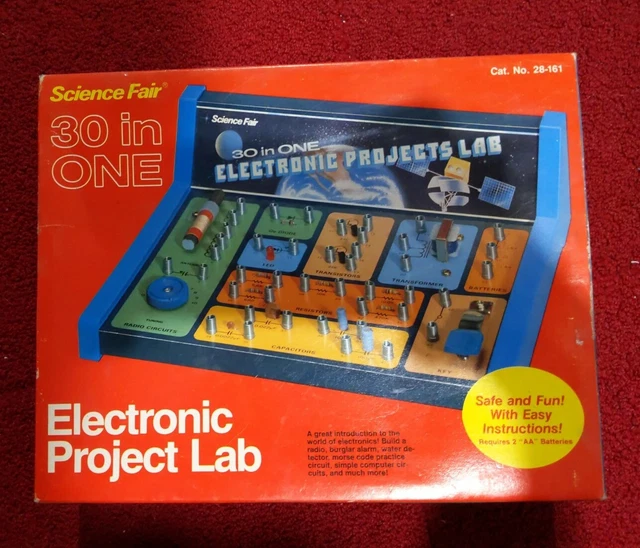
I had one of these. From the pictures, I cans see it was was the 200-in-one.
I built things from the book, and tinkered, but didn't really learn anything from that.
I got into it properly circa 2012. I probably learned more in one week than I ever did from tinkering with that. Electronics requires proper study. For any circuit of moderate complexity, your intuition for what is happening will be poor without the background. The hands-on experience and familiarity that brings about is great, and it was a lot of fun, I always had this lingering dissatisfaction that I don't know what's going on.
I had a computer in parallel with this, and that soaked up my tech-oriented attention.
One problem I remember is that the coil-spring connection method in the kit had reliability issues. The contact produced by a wire clipped into a tiny spring isn't always very good, and if you have a few dozen of them which all have to be good for the circuit to work, the odds work against you. Today I understand why; most likely the layers of oxidation on the wire and coil are the culprit. When you clip the stripped wire end into the coil, there isn't a sliding motion there, or not always, that will break through the oxidation. I suspect the springs are just ordinary spring steel springs, not coated with anything for promoting good contact, like nickel.
If I had one of these kits today, I would give it some TLC to make it more reliable.
I had some of the Philips EE2000 stuff in Germany, and then the Radio Shack 130-in-1 after we moved to Canada. It was all great, however, the manuals for the Radio Shack kits aren't very good at actually teaching electronics. It was a revelation to find, many years later at a thrift store, an Elenco brand kit, same spring clip-through-cardboard technology, but with an absolutely fantastic manual that is a basic electronics education in fun form. That makes all the difference.
More recently, found a 160-ish-in-1 set, the kind with one quad NAND gate, one dual op amp. Challenged myself to do something really hard with it, namely, display incrementing digits on the 7-segment display as the potentiometer is turned. I got as far as 1-2-3-4. It may just barely be possible, maybe, to get to 1-2-3-4-5. I never tried that but I did manage a circuit that displays binary counts from 000 to 111, yes, 7 increments, using three of the LEDs in the 7-segment display. This was intended as a challenge for others, one a teenager, the other an adult, who had shown transient interest in learning electronics, but neither took up the challenge.
I do have a writeup for the 1-2-3-4 circuit if anyone wants it privately (m a r k u s @ w a n d e l . c a), and I think I did make a wiring list for the 000-111 circuit. Both the sets have gone of course, given to the intended challengees.
I literally just found my 200-in-1 electronics kit instruction book in a storage bin today. Taught me a lot about electronics back in the day. Last thing I remember making on it was a crystal radio.
I had the 130-in-1. Yesterday, I was thinking about it for probably the first time in 20+ years - what a coincidence that this link popped up today. I was a bit too young to actually learn much from it beyond the basics, but I remember having a lot of fun with #85, the "Falling Bomb Sound".
OMG I had one of the 160-in-one kits when I was very young ~(mid 2000's) but never learned what it was called! I remember my mom buying it for me from this mysterious shop which had exotic toys (that I never actually visited myself). It was a second-hand one and most of the resistors/components had already broke, But the radio feature still somehow worked! I thought it was magic, just as magic as that strange, foreign shop. Kinda want to buy one now....
I grew up in Australia, with a mix of somewhat similar Radioshack 160-in-1 kits, and the Dick Smith Funway into electronics [0] vol. 1 kit, and later on a few of the Funway vol. 2 and Funway vol. 3 kits.
I spent so many hours with that 160-in-1. I think mine had a Radio Shack badge, but it was exactly that layout, and exactly those components. The CdS cell seemed like nothing short of magic at first.
I can't assess how much I learned from it. But it really cemented a love for tinkering and made me fearless about it.
Whoa, major nostalgia moment. I had, if I recall correctly, the 50-in-1 version. I remember having to replace a transistor and making new connecting wires. I ended up as a software engineer but I know how to read a schematic, solder, and do simple circuit analysis thanks to that kit.
It has that “wow” factor, but as I kid I think I moved on to breadboards pretty quickly. That, and we had a bunch of Engineer’s Mini-Notebook by Forrest Mims III. These kits are very cool but I remember that it felt a little more like paint-by-numbers.
It's amazing how soon after receiving one of these that pretty much all of the other electronic gear I could get my hands on while my parents were at work had missing screws from putting it back together in a hurry as a parental unit was pulling in the drive.
This was a great throw back. My interest in Electrical Engineering was traced back to building out simple circuits on this device. Little did I know my day to day at school was going to involve even more complicated circuits on a bread board - I was in heaven!
I had the Science Fair 150-in-1 kit. It really takes me back to my tinkering. I saw one some years ago on Ebay (among other childhood things) but I thought it's best left to memories.
I had that exact 300 in 1 kit, with the instructions written by the great Forrest Mims. I remember going into RadioShack to order spare resistors and LEDs. What a great flashback!
I had one of these growing up, absolutely fantastic bit of kit for learning. Eventually ended up taking it apart for components, which in hindsight was a bloody stupid idea.
I had one of these, not sure of the exact model. I built AM transmitters, radio receivers, break-the-light-beam alarms, all kinds of things. Magical things when I was a kid.
I had a couple similar ones but somehow failed to learn much of anything from them, maybe I was too young or the booklet they came with was useless to induce any learning besides unthinkingly recreating the presented schematics. Or maybe I learned some circuit basics and don't even realize it. However, I do remember utterly non-comprehending anything that had anything to do with the tunable ferrite core coil.
Wow what a flashback, I'm pretty sure my dad had this exact model in the 80s. I'm remembering most of the components in the picture, amazing. Thank you HN
I had one of these, either the 150 or 160 pictured. Lots of fun. I later got the microcomputer one, which had a four bit microprocessor that you could program.
I had that exact kit in the the photo! So nostalgic.
At the time I was not able to make the leap in understanding to go beyond just following the recipes in the manual to doing anything creative with it, which ultimately was a little disappointing.
But looking back I guess I did learn basically how to read a schematic and the different types of components. And it was neat just getting everything wired up correctly and working.
I looked up some science kits recently and was quite disappointed. Nobody produces anything close to the great kits I used to enjoy as teenager. I was especially fond of my chemistry set. The new versions all seem neutered in comparison. I guess science kits can't compete with all the distractions available to modern teenagers, and these kits were quite expensive making them probably a hard sell. Still, I wish someone would make these again.
Old style chemistry sets with actual glassware and actual chemicals seemed to die a painful death during the GWoT and meth lab panics of the early to mid 2000’s.
The Thames & Kosmos Chem C3000, is a pretty solid chemistry kid for a late elementary early middle school age child. I think I picked it up with an actual glassware kit from amazon ten years ago. At least in TX they have repealed the dumber restrictions on glassware. In the US the local Barnes and Noble stocks science kits, as do science museums, and the internet is a source for a lot of this stuff from places like https://www.homesciencetools.com/. Getting chemicals for some of the more "dangerous" reactions sometimes takes a bit of digging, or simply knowing how to synthesize it for your kid, who of course should probably have a parent on hand anyway.
And of course ebay and archive.org/etc is a source for the old manuals or even kits (I recently saw the SFX-4000 aeronautical lab kit in an old fashioned toy store in town BTW) if you can't be bothered to grab the manual and do a bit of footwork to restore an old kit. But frankly people have to fond of memories for those kits. For example, a good used microscope from a college can be picked up on ebay and some slide + stains for just a few dollars these days and its a far more useful tool that the cheap toy oriented kits. And while I printed and bound a copy of the golden book of chemistry some years ago, one should really read more recent criticisms of that book before handing it to your child (ex; don't go tasting lead based compounds).
Yeah, this. I suspect I'll have to cobble something together myself for my kid. I have fond memories of making crystal gardens, distilling wood gas, bending glass tubes, making gunpowder, etc.
I have an unused breadboard. I bought a couple of Radio Shack Science Fair kits a few months ago.
The scale and design of the Radio Shack kits has worked for me and I have actually tinkered after decades of being off put by breadboards.
The Radio Shack kits are not professional tools which is a feature not a bug. If you have always wanted to play with electronics, it might be worth picking one up on eBay.
I had one of those 160 in one kits, it reminds me that I also had a much smaller kit that was a raised plastic design with only a few components on it. The small one gave me the magical experience of building a crystal radio with no need for batteries.
The number of comments that start with "I had" or "I have" is crazy, but cool. I think I got some version of my own at one point, but mainly remember playing with one belonging to a sibling.
They were quite popular back in the day, so a lot of us old farts had them. I wish stuff like this would come back, although the newer alternatives are quite wonderful. I don't have anything against all the Arduino (or whatever) kits out there, I just wish today's kids could get a box of basic components and wire everything to work without a computer or microcontroller involved. I think it's a great way to learn.
I had one of these when I was around 6-8 years old. I did a few of the projects, but never spent much time with it until I realized I could hook up each part to an extension cord and when I plugged in the extension cord the part would explode.
I spent a lot of time as a kid just making sparks. I loved taking batteries, wire, and a steel file and running the wire up and down the file while it sparked.
Totally brainless, yet somehow I still managed to become a EE and an extra-class HAM.
These were neat. I had the 50-in-1 from Radio Shack. I would play with it before school in the mornings. Definitely the thing to pique a kid's interest in electronics easily and safely.
Most of the kits mentioned in the article are analogue electronics circuit kits. In recent decades there has been large growth in digital kits , mostly with microprocessors
i had one of these and was determined to learn everything about electricity. i started building the projects in order, keeping many notes, over and over again.
it was only many years later finding the set under a pile of junk at the back of my mum's garage that i realised the manual had pages printed out of order; paragraphs missing; nonsensical translations and errors upon errors, and i felt sorry for the young me who didn't stand a chance
OH wow, had something similar, but from around 1968. Good humor. Pretty quickly moved on to vacuum tube based Morse code transmitters. Wonderful stuff.
Man I coveted these soooo much as a kid. Along with flashy inline skates and high top trainers these were the thing I wanted most and could not afford.
as a kid in the 80s my dad gave me one of the smaller 10 or 20 in 1 kits. The most fun was wiring up the am crystal radio. Would often fall asleep listening to programs and shows such as Art bell coast to coast or cbs mystery radio broadcast from cities thousands miles away.
My first experience of these kits was one from Maplin (a now-defunct EE shop here in the UK). It was good, but in the post-Radio-Caroline world, the power output from the radio transmitter project was pretty pathetic.
Then my uncle brought back one of these 160-in-1 kits from the US. No such problem there! This thing could broadcast to the whole neighbourhood. I must have annoyed everyone and broken so many laws in the process.
> See also: the paradox of choice, analysis paralysis, etc.
I like this blog post but I disagree with this conclusion. I think it is regularly the excitement of the idea of crafting something that leads us to buy things we have no projects for.
It was a lot more robust than the spring-based electronics experimenter systems, and its built-in shield meant that my experimental circuits could survive the transport to school and the inevitable attempted rip of cables from the bullies, in order to show my favourite Math teacher what I had been up to over the weekend, and that led him to give me a student key to the schools computer room, and free access so I could hone my skills.
I still collect Denshi Block systems, and the day I got the EX-181 with its synthesizer module was particular joyous. In Japan, Denshi Block systems were used in electronics engineering schools, and they were much, much larger and with a bigger variety of component modules .. I'd love to have one of those one day.


The highlight was when I was futzing with a slow oscillator and accidentally discovered that using using the speaker transformer as a voltage step up I could get the inductive voltage spike when the relay switched to give a painful shock.
I wrote down that wiring diagram so I wouldn't lose it. One of my brothers had built a 9V variable power supply in a high school shop class, so we made use of that to create a pain game: hold the two leads and turn up the 9V supply output until you gave up. Whoever got the voltage knob the highest won. Our arm muscles would be involuntarily twitching, like a TENS unit.
The other game was one person would hide it in the house somewhere, say a closet, and the other person would use an AM radio to locate it, as the spike would release broadband RF energy which could be picked up by the radio. The closer one was the louder the clicking would come out of the speaker.