Cool. What would applications be here? Could we for example make basic alloys of vehicles, railroad tracks, and refrigeration systems more resilient when they undergo temperature variations, and therefore last longer?
Well, they knew the effect existed, so applications are already in use; this just explains the how, which I'm sure makes the effect more predictable - and allows for researchers to find more alloys with this effect in a focused manner, instead of via trial and error.
As for applications, it probably won't be garden variety appliances, thermal expansion isn't much of an issue there and designs for all of the things you mentioned have been tweaked a hundred years ago to deal with thermal expansion (although railroad tracks are still an issue sometimes). And of course there's other parameters, like wear resistance; nickel is a pretty soft metal I believe.
But, things like precision industry or space will find a use for this. Sattelites have to deal with hundreds of degrees of temperature variation.
Invar is actually a very bad material for most uses, because having zero CTE usually won't match the rest of your system's nonzero CTE. So things will fail pretty quickly.
Matching CTE is a big deal in careful engineering. "Alloy 42" is a great example of that in action: it's an invar-like alloy with its CTE matched to silicon, so chip lead frames expand with silicon dies as they heat up during operation. Not that many things use lead frames anymore....
What do you mean? MOST ICs use lead frames still. Although there is a large push in consumer electronics to use flip chip or CSP devices, I would suggest that most devices are still using lead frames. Any plastic packaged device is lead frame based.
Sorry, you're right, I was thinking of the newer stuff (flip-chip, wafer-scale, nearly-bare-die, etc). It's also interesting just how few leadframes are magnetic these days, even for something ancient like a SOIC-8. I don't know what they use; I guess it's not very important if there isn't much power dissipation.
I disagree, even modern cars have a lot of unsolved problems with thermal expansion and cracking causing failures of cylinder heads, gaskets, exhaust manifolds, turbochargers, etc.
It may be solved in principle, but certainly not in practice.
There are problems that are game stoppers and there are problems that are unavoidable. Cars work. Yes, if you drive 1 million miles you will have cracks in the engine due to thermal expansion, but who cares? Make a new engine and get over it.
Now consider a space elevator. Material problems are a game stopper.
I didn't even know that they didn't have a good explanation related to magnets, as invar for example has a curie point, above which it loses it's neutral thermal expansion properties.
I've seen it used for low temp things or tooling but for that reason it can't be used for anything really high temperature.
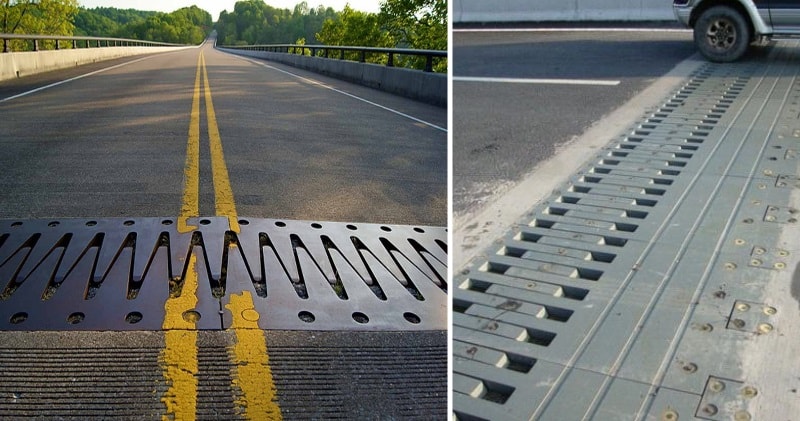
No need - you ever cross a bridge and note a mesh of metal teeth? Thats for thermal expansion. Its already designed around and isnt generally noticeable - for steel it is 0.0000065 / °F [0].
Why is that? I've already put all my knowledge on the topic on display so I can't tell if this is a joke about aesthetics or if there is actually something neat having to do with the gaps
I know from tales of professional cycling that those metal bridges are vastly disproportionately responsible for broken bones.
They're also squirrely when wet, and if you've ever ridden across one on a bike or a motorcycle, they are fucking terrifying because you can see the river below you, and the railings for some reason tend to be very low.
And while I understand that many bridges don't really prevent runoff into the water flowing beneath them, metal mesh bridges really can't.
I'm not sure you're talking about the same thing though, I think they meant these thermal expansion joints, not necessarily a bridge made from metal mesh:
I think they meant the former, because otherwise having expansion joints that don't expand doesn't really accomplish anything. The concrete still expands, hence the need for the joints.
My reading is that they were saying this expansionless material isn't likely to be useful for bridges, because thermal expansion is well managed by these traditional techniques.
I agree though that both the thermal coefficient of the teeth probably don't impact their performance (the expansion in the teeth relative to the width of the gap is negligible, so we can probably pretend we're using expansionless teeth already), and I've never had an accident on one of these bridges, but I'm sure you're right and that the mesh concentrates the force on your bones like a golf club.
The whole idea with reinforced concrete is that concrete has thermal expansion very similar to that of steel, thus both steel rebars and the concrete that encloses them move in the same manner.
A rule of the thumb with bridges is that the movements (thermal expansion/contraction + elongation or contraction due to loads + in case of pre-stressed concrete fluage/creep) is in the range of 6-9 mm every 10 m.
Expansion joints on (long) continuous beam bridges can thus need to have very large displacement, up to 1,200-1,400 mm are relatively common.
> and the railings for some reason tend to be very low
This isn't just a problem on bridges. Guardrails in shopping malls seem to come up to thigh height, well below a normal person's center of gravity. I hate it and I can't understand who thought that would be a good idea.
I want guardrails that -- if I should happen to be propelled into them -- will stop me from falling over the side. Not rails that will tip me over headfirst.
I'm actually just talking about the expansion joints! Like one or two places that are metallic, the rest can be concrete. I havent biked over one but I expect that they are one of the least hazardous of the hazardous terrains - I'm comparing them mentally to pot holes and rail lines (not sure the right for them, street car lines that as it turns out are perfectly shaped to get a bicycle tire stuck in while at speed).
Just between you and me, fuuuuuck those metal grates on bridges. I'm grateful that I have almost always had the opportunity to get onto a good sidewalk/path instead of navigating a bridge with an 'interesting' surface.
Only precision applications can afford the high cost of specialized materials. All the things you mentioned are unrelated, as they are cost driven and steel will always win.
From the understanding of the mechanisms that cause this invariance, many other applications could be derived, that even don't need the invariance property. For example materials of which cooling systems (e.g. Peltier-like) can be made. Also their measurement methods seem pretty advanced and could be used within other research like in the area of nano technology.
Yes, the main value would probably be in better understanding the temperature / pressure / volume / magnetism relationship within invar-like materials. Perhaps the result will be new piezomagnetic applications, or magnetocooling applications, and so on.
Tangent: reminded me for some reason of the lengths (ha ha) clock makers went to to account for the expansion and contractions of the clock pendulum. To keep consistent time the length of the pendulum too needed to remain constant. Enter the brilliant John Harrison:
Probably not. You typically cannot change one variable in isolation with an alloy, so while you can gain in one area other things change as well. Strength - both compression and tension, hardness, resistance to bending, springiness, melting temperature, are just a few of the properties (note that the properties have engineering names and common names - I mixed with no concern so there is duplication)
> That anomalous behavior makes these alloys useful in applications where extreme precision is required, such as in the manufacture of parts for clocks, telescopes, and other fine instruments.
I was going to say something similar but then I started having doubts.
For precision instruments you probably want devices that have exactly the same modulus of expansion as what you are cutting. So that 0.15m is always 0.15m no matter the temperature of the factory.
For molds you would want the outer mold to shrink slower than the molded material, but would you perhaps not want an inner mold to shrink faster? So that the material pulls away from both as it cures/cools (I'm asking, I don't know)?
> That anomalous behavior makes these alloys useful in applications where extreme precision is required, such as in the manufacture of parts for clocks, telescopes, and other fine instruments.