Sometimes I don't think we realise or appreciate just how old things are and how they've survived through consistent and conscious effort. A century is beyond the lifetime of most people. A lot of similar-style public transport in the US was practically killed between 1920-1940 with the dawn of the car.
In the UK you might live in a house that is 100 years old, and in London you take a tube train through a tunnel carved out 120 years ago, or something. But it rarely registers that you are using what we in tech would consider way beyond a relic.
Your automated train on the Victoria line was done in the 60s or 70s, the DLR (similarly automated) a decade later. They were so weird at the time that, story has it, the drivers couldn't read a paper in the cabin because it freaked passengers out. Despite the fact they weren't in direct control. Still, automated is weird and it's half a century old.
So what does this say about other historical events that are slipping beyond our collective conscious, like the two world wars? Or even something like 9/11 where there is a whole generation who never saw that?
And what does it say about knowledge? What we keep in our awareness and what we pass on to historians?
100 year old houses are relatively new by UK standards. A large proportion of the urban housing stock is Victorian terraces (i.e. pre-1900). Rural houses are usually older. The suburbs/urban sprawl are the main exceptions. [1]
Partly this is because we don't build enough new houses, but it does mean there are lots of lovely old buildings. My house is 250 years old. It's nothing remarkable. Next door is about twice that age.
I currently have my office in a building that was built durinf the year 1265. Still to this date I find this fact fascinating whenever I get reminded about it.
I think prior generations seem to be less self aware than we are now, either that or they've experienced more 'wonders' of the age. I cant ever remember a story about the first time someone saw a car, a plane, a jet, the moon landings. Whereas now we seem much more willing to discuss our first computer/ mobile phone, the early internet.
Conversations with my grandad about the war were limited to stories about scorpions in boots etc. I can't imagine younger generations being so silent on the subject.
I’m curently living in an 18th Century thatched cottage. It’s a cobb cottage, so made of compressed clay and straw. I love it, except for the low ceilings and beams, on which I’ve whacked my head many a time.
I suspect we live in an anomalous time in the history of software. Already, I feel like the ecosystem is settling into a form it will retain for some time. A hundred years from now, our descendants will still probably be using Linux, and they'll see it as much as a relic --- or not --- as we see old subway tunnels.
There are a lot of problems with twitter, but it's great for people who want to share a short thing like this.
From this thread I particularly enjoyed the video of a steam train in an underground station.
I don't know why I enjoy twitter threads like this so much. I hate "factoids" (eg snapple bottle cap real facts), but these twitter threads feel a bit more truthy.
What exactly am I to do with the link provided, on the desktop? I click on it and I get the first part of of the message 1/6. There is no intuitive way to continue reading. If I click the replies button, I'm invited to join Twitter. Why should I do that?
As you can imagine, I have the exact opposite feeling, this is the absolute worst way to share a story. Pushing the "network effect moat" pedal to the metal by denying service to non-memebers. Not even evil Facebook takes it to this level (it used to, though).
it's text, with images interspersed. it's a perfectly usable way to present information. to read it, you just keep reading - all the information is there on the page. or are you not seeing something that looks like this:
I find Twitter pretty great for for traffic or transit problems. There are usually people complaining or posting about it within minutes of the problem and i've usually gotten more accurate up to date info about local things like that by scrolling through Twitter threads about them than official statements.
Also the police scanner ones are pretty great. They're how I learned about a naked man that chased a pig down the street one night in the middle of the city.
While the mixed signage in the thread refers to the Metropolitan line part of Moorgate station, there's a similar mix going on in another part of Moorgate station, specifically the part that's the terminus for the Northern City line (https://en.wikipedia.org/wiki/Northern_City_Line).
It's very anachronistic in terms of London stations - its platform design (and that of most other stations on the subsurface part of the line) is still in the "Network South East" colours and fonts, which for reference hasn't technically existed as a concept since 1994. Just think - a colour scheme now 24 years out of date!
It's a line that isn't on the main Tube Map as it's technically part of the National Rail network and isn't run by Transport for London, even though if you wanted to travel from Moorgate direct to, say, Finsbury Park, the Tube Map would have you believe you need to change at Kings Cross.
(Though mostly this doesn't matter as the vast majority of passengers are commuters from the northern suburbs into the City anyway.)
I had to take this line (Moorgate to Enfield from platform 9) during a strike once, and it was the creepiest experience: across all carriages, there was about two non-white people. For a city as diverse as London, this is pretty unusual. It made the train look like some kind of white flight express.
London has loads of pockets of areas where diversity is low. Not just white folks, but every ethnicity and religious background will have a pocket of low diversity in London.
How are you defining "white"? That line serves a number of Greek/Turkish areas (through Harringey in particular). Enfield proper is indeed quite a white area, though I don't think anyone would see it as an aspirational leafy suburb.
The services on that line terminate well outside London - distinctly non-urban dormitory towns like Stevenage, Welwyn, Letchworth, etc. A lot of the passengers are commuters from those towns.
Edward Watkin was amazing. Metropolitan Line? Check. Channel Tunnel? Check. Great Central Railway, the first inter-city continental-gauge railway in Britain? Check[1]. Pioneered a difficult ascent up Snowdon, the highest mountain in Wales? Check[2]. Planned lucrative housing development along public transport infrastructure, known as Metroland? Check[3].
Geoff and Vicki are awesome. I loved Geoff's series on "Secrets of the [name] line," especially the one that concluded with the Waterloo & City Line where he revealed the little tidbits that had been hidden in the previous videos. (And "Secrets of the Cable Car" was hilarious.)
Vicki also makes an excellent presenter. Her "solo" video about Harry Potter Locations around London, and particularly the tube, was great.
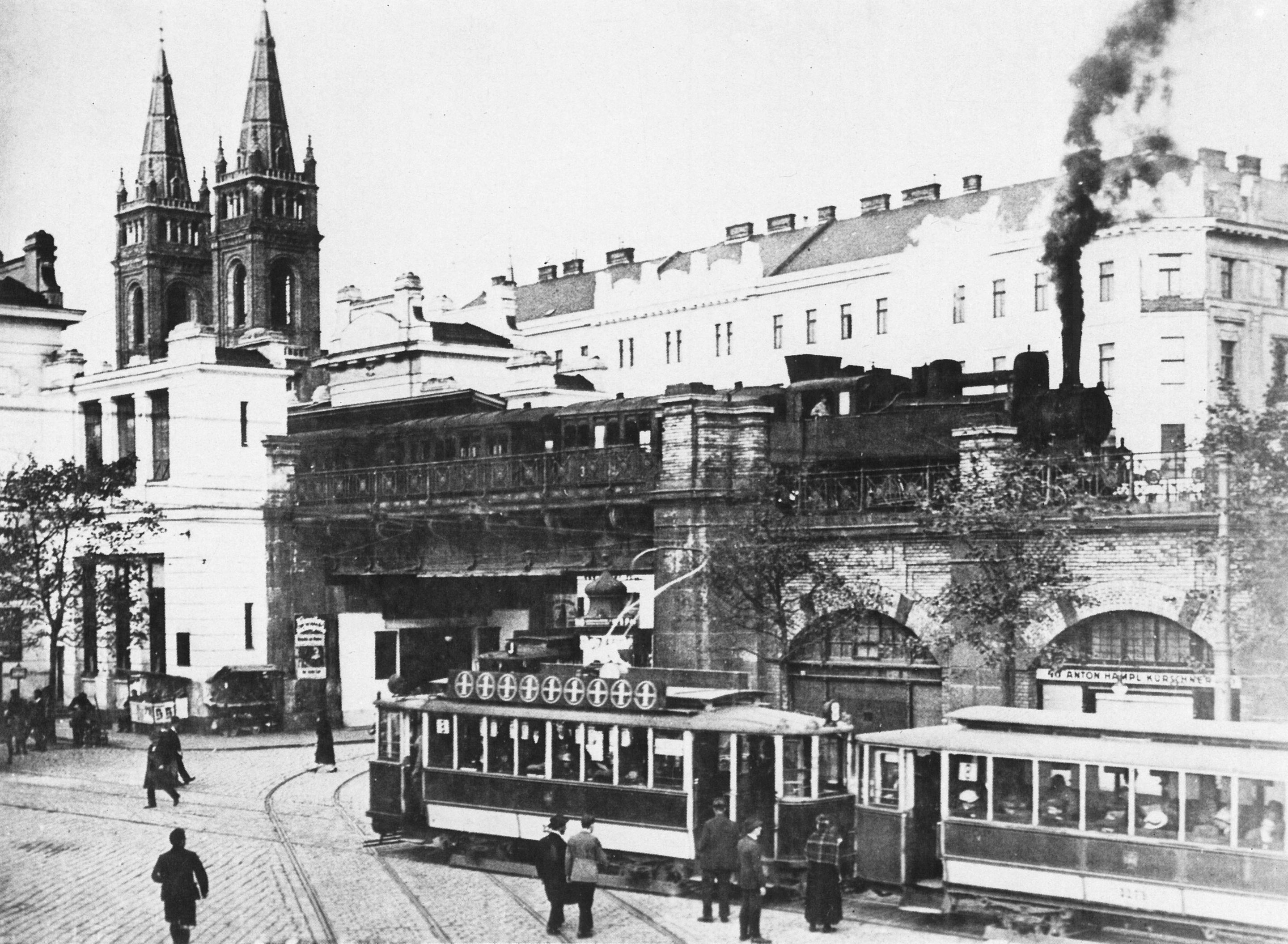
Similar things happened in Vienna. The U6 line is completely different from the rest because it was originally a Stadtbahn and not a subway. The rolling stock to this date cannot be used in automated operation at all, has different electrification (overhead wire and not third rail), has lower platforms and still retains many of the old signage.
It's now a proper subway by all accounts but still retains some of its weird history. For instance there is still a track connecting to the tram network so you can sometimes see a subway train go on the tram network for maintenance: http://www.vormagazin.at/tools/imager/imager.php?file=%2Fmed...
I always find it very interesting when some old things stay around and become integrated into something else and that transition period never really ends. Many transit networks in Europe have history like this and it's fun to rediscover this history.
Replicating the Eiffel was all the rage for a while, the Japanese did it in Tokyo in the ‘50s and I’m almost certain there are other replicas and attempts around the world.
It’s one of those weird twists of fashion: the Eiffel serves no real purpose and most people thought it was a pointless exercise, but it was so absurd that it went all the way around and became iconic - so much so that people started copying it.




In the UK you might live in a house that is 100 years old, and in London you take a tube train through a tunnel carved out 120 years ago, or something. But it rarely registers that you are using what we in tech would consider way beyond a relic.
Your automated train on the Victoria line was done in the 60s or 70s, the DLR (similarly automated) a decade later. They were so weird at the time that, story has it, the drivers couldn't read a paper in the cabin because it freaked passengers out. Despite the fact they weren't in direct control. Still, automated is weird and it's half a century old.
So what does this say about other historical events that are slipping beyond our collective conscious, like the two world wars? Or even something like 9/11 where there is a whole generation who never saw that?
And what does it say about knowledge? What we keep in our awareness and what we pass on to historians?