> If someone's blocking [a bike lane] for thirty seconds while they get their groceries or drop their kid off, I don't think they should get a ticket for that.
Do you agree? And do you have any data on how much of the blocking going on is A) the "thirty second dropoff", B) driving in the lane, and C) stopping and parking for any period of time?
Lastly, I'll add that as a walker in NYC (no car, no bike), I have no fear of being struck by cars. I fear bikes. I rarely see bikes obey traffic laws at all, and have frequently come 1-2 feed away from being side-swiped while a bicycle blows through a red light. Since you're so passionate about this I'm sure you follow traffic laws, but maybe you'll be inspired to take a look at bike behavior too!
Bikelanes are for cyclists. Blocking them even for 30 seconds endangers the cyclists, how will have to merge into car traffic.
That your mayor does not understand this, is testament to his ignorance of the issue.
Blocking a bike lane is potentially causing severe injury to a bicyclist, as now your car is blocking their path and they could end up smashing into your illicitly parked vehicle.
I've had friends end up going through the rear windshields of cars, getting doored, etc here in Seattle, so even though I don't bike, I make a point to go and harass people illegally parked in bike lanes (which is really common north of the ship canal).
What if a bike can't stop in time coming down the hill? They're going to likely get horribly injured due to your illegal parking job. The bike lane is for bikes exclusively, even in the suburbs.
Failure to control speed is a moving violation and should be ticketed appropriately. What if a person is crossing the street and, according to you, a bike would be potentially unable to stop?
Any vehicle on the road has a legal obligation to operate their vehicle safely and lawfully — that means a bike ought never be unable to stop in time.
Some person could get horribly injured due to a bicyclist failing to control speed.
> Any vehicle on the road has a legal obligation to operate their vehicle safely and lawfully — that means a bike ought never be unable to stop in time.
Would you make the same argument about leaving unmarked construction equipment behind blind curves on the freeway?
Blocking or unexpectedly merging into downhill bike lanes in the city is similarly bad.
Coming down a hill at 20Mph in a bike lane that should be at least partially clear on a wet day (very common in Seattle) is perfectly legal. Running into a large unexpected object in the path is hardly the cyclists fault.
If your reflexes are good enough, and your brakes are good enough, and your tires are good enough, that you can safely stop a bike going 20mph on a wet downhill section, then yes; you are still in control of your vehicle and operating at a safe speed. No legal problems there.
But maybe your reflexes aren't that good because you haven't had coffee yet. Or maybe your brakes are worn down. Or maybe you're on crazy thin road tires that have effectively no traction going downhill in the rain. Or some combination of all three.
The point being, if it's not physically possible for you to stop that bike in whatever time interval is required, are you really operating that vehicle safely? Probably not.
And to the extent that you're legally required to operate at a safe speed and maintain control of your vehicle, your behavior would no longer be "perfectly legal."
So 20 mph + downhill + wet roads may very well be illegal for some combinations of cyclist and bicycle but not others. It seems premature to declare that perfectly legal in all cases.
Someone suddenly stopping shouldn't be unexpected, nor is it necessarily against the rules of the road. Hacker News is fun and all but consistently gets beaten by 15 seconds of googling e.g. https://www.nytimes.com/2014/05/28/nyregion/double-parking-i...
If you can't see whether there's a large object in your path within time to stop, you're going too fast. There could be a fallen or slow bicyclist in the lane.
You’ve clearly never been going downhill on a bike and had someone illegally stop their car or pull out in front of you. Bikes take more distance to stop than cars.
That’s the point. People in cars have to be able to avoid objects in front of them (whether that’s drivers suddenly stopping or other obstructions) and so do bicyclists.
now your car is blocking their path and they could end up smashing into your illicitly parked vehicle.
I've had friends end up going through the rear windshields of cars
I agree with the arguments about moving cars pulling into the bike lane, doors opening, etc, BUT if you can't avoid smashing your bike into a parked car with enough force to go through the rear window, then you definitely aren't skilled or responsible enough to be riding in the city.
Of course. My belief is that if you ram your car into a stationary object, regardless of the conditions, you're at fault. Either you weren't paying attention or you were driving too fast for conditions.
It would be instructive if more people took motorcycle safety training. They really emphasized that you should ride as though there could be a dropped load of concrete, boulder, or pothole around every corner, every blind hill, or every car, and stop accordingly.
I think this is mostly because the consequence of hitting debris is much more likely to be fatal on a motorcycle, but it would be good advice for anyone, really.
You should see the driving and biking conditions in Seattle. Expecting a bike to stop on a dime when coming down a hill just after it rains is wholly unrealistic.
First, I don't understand why you need to "stop on a dime" to avoid a stationary object ahead?
Second, a huge part of safely operating any vehicle in an environment (especially a chaotic one you share with cars, bikes, and pedestrians) is awareness of your surroundings and the ability to avoid collisions. This is seriously driving / biking 101.
If you are zooming around on your bike and just thinking "hope no objects / people / cars are sitting stationary in my way because there's no way I can stop and I'll definitely hit them", then you're a dangerous menace.
I think you are making the wrong argument here. A bicyclist should have control of their bike. If there is injury involved, that is on the cyclist. (Dooring is another issue.)
But I think the problem becomes very clear if you allow another car to pull up next to the one in the bike lane and stop in the middle of the lane to berate the first car. Just for 30 seconds or so. If somebody rear-ended that car, the person in the moving vehicle should get a ticket. But what should be the consequence to the person stopped in the middle of the lane? Would the mayor be so casual to "30 second" stops if car lanes were blocked by parked cars 40% of the time?
I once had to go around a car stopped in a bike lane, slid and fell badly while trying to re-enter the somewhat elevated bike lane (about two inches from the road -
it's like a red painted sidewalk, two feet wide, with a bevel on the edge). The driver was inside the car having a phone conversation, so he was probably stopped there for just 30 seconds -
enough to cause a bicycle accident.
You could have, you know, stopped and waited for the car to start moving. As cars do when blocked.
A post elsewhere hear said it already, but it’s my experience too: cyclist break laws constantly, due to apparent feeling of entitlement to keep moving fast, regardless of the traffic, lights etc. the thought of just stopping safely for a few seconds didn’t even cross your mind in the situation.
No. Sorry. They did not cause an accident. It is important that your understand this.
Note that I am not sympathetic to the driver of the car. They probably deserve criticism, but not blame for your slide. I know that you want to blame somebody that is not yourself. That's human. But when any pedestrian, bike, car, airplane, drone, skateboard, etc. runs into a stationary pedestrian, bike, car, airplane, drone, skateboard, house, fence, animal, etc. it is almost certainly the fault of the moving object's operator.
In your case, you failed to change lanes safely. It sounds like you really blame the lane design for having a bevel between lanes. It's interesting to me that the bevel probably has almost zero effect on cars/trucks but a significant effect on bikes. That seems like a bike-hostile design. The fact that it is only two feet wide seems questionable to me. A slow-moving bike would also encourage you to change lanes, navigating the bevel twice.
So by the same logic, if you stop your car in the middle of the highway and someone slides into the parapet after going around it, you did not cause an accident?
I agree with the bike hostile design part. Navigating the bevel downwards is not a problem. Navigating it upwards at a steep angle of attack is.
> As for getting doored, well, how are motor vehicles avoiding this? Oh, right, by WATCHING WHAT'S GOING ON.
Motor vehicle drivers don't have to worry much about being doored, as they're way more visible and it isn't life-threatening for them if it does happen. The person opening the door is way more likely to be injured in such a scenario than the driver of the oncoming vehicle.
Also, if we biked the same way we drove cars, that is, in the middle of a full lane, then we wouldn't be at risk of being doored either. I do that on occasion as necessary, but you would not believe how furious drivers get when they're stuck behind a cyclist going much slower than them that they cannot pass.
How about this -- You can make it the cyclists' fault if and only if you can get all drivers to be OK with cyclists taking full lanes of traffic, away from all car doors. This will likely reduce the max speed of vehicle traffic to around 12 mph.
NYC has a law requiring cyclists to stay in the bike lane if one is present. Only more civilized cities (like Boston ;) allow bikes to take the full lane. Although traffic moves so slowly there's rarely a point unless the bike lane is blocked.
You're missing the point, which is that bike lanes are frequently in door zones whereas main travel lanes are not (because they are much wider and have more buffer zone).
The other day I was riding down a normal surface street in Seattle and a parked late model Camaro with black windows started its engine and pulled out from the curb in a few seconds. There was no angle that would have allowed me to see if this car was occupied.
I was able to stop in time and avoid an accident but if I had not reacted I would have ended up on his roof. In your opinion was I in the wrong?
You don't sound willing to give cyclists any support when you condemn the entire group for the actions of a few and disregard legitimate threats to their safety.
No, you practiced safely operating your motorcycle. More should be as responsible.
I've always been willing to support cyclists but cannot ignore the staggering number of them that completely disregard traffic laws on a near constant basis. And then come online and winge about the risks TO THEM while ignoring the risks THEY impose on others. In the name of what, being able to maintain their momentum? Sure, I'd love to do the same, yet abiding by traffic laws is a bit more valuable that my selfish desires.
Downvote all you like but understand you're downvoting someone that does cycle and has a lot of respect for the challenges presented doing so in an urban environment. You're downvoting someone that favors the activity but has taken the time to point out you're being pompous assholes QUITE a lot of the time when you're out and about on two wheels.
The bike lane is entirely within a door-length. Cars are already on both sides (parked on one side, driving on the other), so cyclists often have nowhere to go. Drivers and passengers being unaware of cyclists is not the cyclists' fault!
The mayor's view is consistent the engineering rationals for bikelanes. Bikelanes are for cars. Not in the sense that cars are meant to drive in bikelanes. In the sense that bikelanes exist to relegate bicycles to second class road use for the sake avoiding inconvenience to motorists. Ticketing cars for standing in bikelanes would inconvenience motorists.
Going 3d with dedicated bike skyways can solve this problem, but bikes are 3rd/4th class citizens in most places because they get a relatively small fraction of overall transportation. (Cars, walking, subways or other public transit, then biking.)
Crossing a bike lane isn't the same as stopping in it. You can check that there aren't any bikes in the bike lane before crossing it to park. You can't check that there won't be any bikes in the lane for the next 30 seconds before stopping to load some groceries.
I believe the biggest problem is due to the design of bike lanes. They are often narrow and squeezed between car lanes and car parking. Due to this design bike lanes are also more often subject to being blocked by construction and forced to merge with car traffic. The visibility on bike lanes are way poorer than regular car lanes due to the above factors. In cities you also have to deal with the loading and unloading of goods. This means large, tall vehicles blocking the sight and often crates and people moving in your lane.
How often do you experience your whole lane blocked by the content of a whole appartement?
In Stockholm where I live snow, and ice make bike lanes hard to see and also makes them inaccessible.
I really agree that you shouldn't keep a speed where you can't control your vehicle, but so common design flaw puts an unreasonable amount of responsibility on the biker compared to heavier vehicles misusing the bike lane.
As a regular biker in NYC I would agree. But there is a cultural gap that we have not bridged yet. NYC was designed for cars (as were most cities in America). The biking ecosystem has made huge strides in NYC in the last decade - from CitiBikes, to dedicated bike lanes, to the massive increase in daily bikers.
It's pretty difficult to argue that NYC was "designed for cars" in the same way as Houston when much of it was designed in the pre-car era. See for instance Manhattan's street grid designed in the 1800s, and large parts of the other boroughs. It's true that parts were REdesigned for cars to some extent, taking away street space, adding highways, etc.
Source: researching my ancestors' addresses in NYC from 1880 onward and seeing how many of the streets from then still exist now.
(Re biking in NYC, it's great to see the changes.)
Not sure where your at, but this is generally considered poor road design, and even on 2 lane streets you'll add a bike box to keep drivers separated from bikes. Having 2 ton boxes of metal and glass interact with bikers unpredictably is risky!
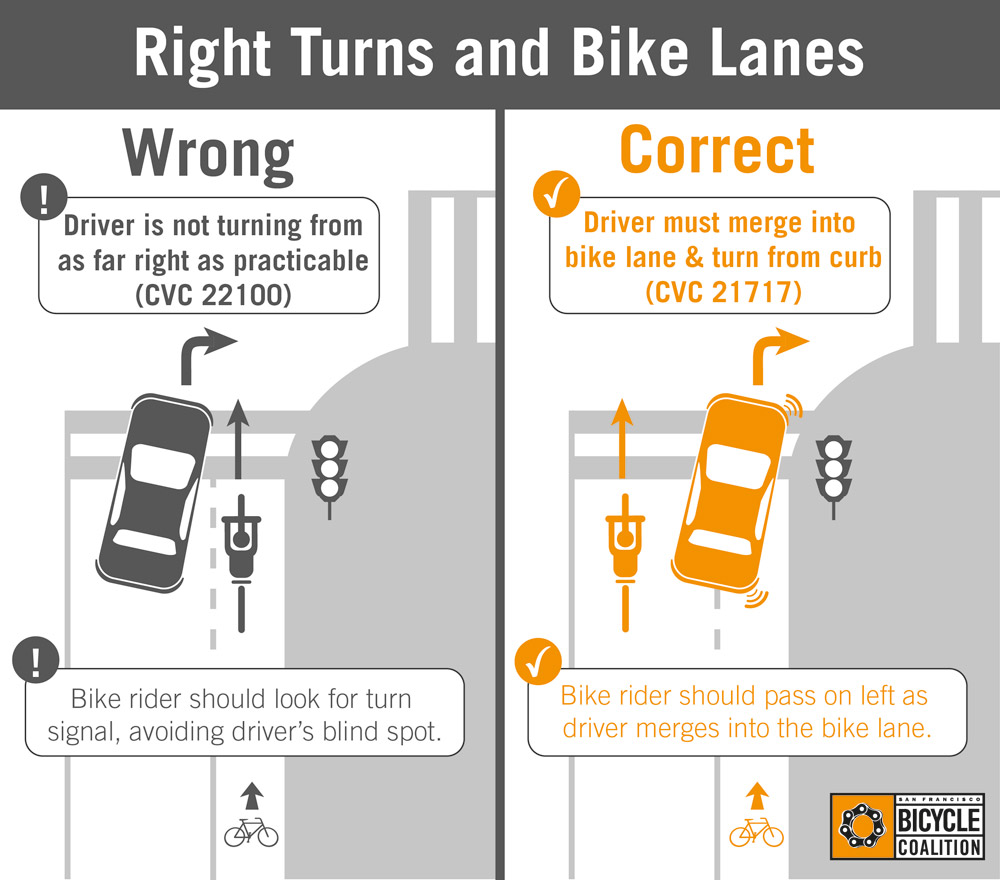
> To make a right turn, drive close to the right edge of the road. If there is a bike lane, drive into the bike lane no more than 200 feet before the turn.
This is also true in Washington State. Not sure about Oregon.
Up here in Seattle, SDOT got rid of this style of bike lane over the past few years. Outlying suburbs keep the edge of the bike lane solid at turns (not like the dashing shown). Portland has gone the same direction, separating bicyclists from drivers as much as possible.
Having spent some time in Cali, I very much appreciate our infrastructure up here. Lots of law and order type politics down there, but when it comes to actual issues like public health, its given nary a glance till upper middle class people are dying.
In Oregon, moving into the bike lane to make a turn will get you a ticket. I see people do it pretty often however, and I have only ever known one person who got caught.
Which COMPLETELY ignore the recklessness continuously perpetrated by the CYCLISTS. There's no endangering here, certainly not at the speeds the cyclists should be operating their bikes in a congested situation.
How fast do you really think they are going? 15 mph is a pretty good clip on a recreational (non-racing-style) bike. Most people I’ve run across are doing 12-15 tops.
I don’t notice any complaint in your post about how cars are flying along recklessly at more than twice that speed.
When I regularly rode in London I'd do 7.4 miles in 35 minutes on a Brompton, average of 12.5mph, but factor in red lights, hills etc and peak speed must have been 20.
> I have no fear of being struck by cars. I fear bikes.
Piling more anecdata into the pile, I've got two things to offer:
1. I'm worried about both; I've been almost hit by both, my wife's been dinged a bit by a car while walking.
2. As a biker, I also worry about hitting pedestrians - because they're so often blundering out into the bike lane or the street without looking. Granted, a bike is more difficult to see than a car - partially because people aren't really used to looking for them - but still.
Just like cars, bikes have a responsibility to look out for pedestrians and other vehicles and avoid hitting them. At the end of the day, you can try to blame a pedestrian for "blundering out" but you will be the one getting the fine because as the vehicle you are the one posing the biggest threat.
Also, as the op pointed out, bikers are largely ignorant or disrespectful of the law. If it's a red light and a bike blows through it, is it really the pedestrians that are the problem for not watching for illegal bikes?
Similarly, for cars turning or other traffic backups, other cars have to deal with this all the time. You stop and don't hit them and wait for the road block to clear. Sometimes traffic jams happen. If you can't stop in time you are going too fast for your vehicle and conditions. Cars accept this, but I've seen dozens and dozens of bikers both not knowing the rules of the road and/or getting irate at regular traffic thinking that somehow they are more special and deserve everyone getting out of their way in a jam.
> Just like cars, bikes have a responsibility to look out for pedestrians and other vehicles and avoid hitting them.
If, as a pedestrian, you dart out in front of a car or a cyclist going at legal speeds, and there isn't room to swerve to avoid you, you're going to get hit. Period. Physics is inviolable on this count. Stopping distances are what they are.
You could just set citywide speed limits of 5 mph to decrease stopping distances enough to allow vehicles to avoid darting pedestrians, or pedestrians could just not step out in front of vehicles that have the right of way.
It's really not hard to, as a pedestrian, upon reaching a road or bikeway, look for oncoming traffic and yield to it if they have the right-of-way. If you insist on stepping in front of oncoming traffic and you get hit, that's on you.
> or pedestrians could just not step out in front of vehicles that have the right of way
Please note that in my original comment I was talking about bicycles which do not have the right of way, because they are going through a red light while pedestrians have the walk signal.
I was quite serious when I said "I rarely see bikes obey traffic laws at all". If you live in NYC you know what I'm talking about. They fly through red lights and stop signs putting themselves and others at great risk.
Bicycles are the reason that I carefully look both directions, usually twice, even when I have the walk signal when crossing the street.
When I was blundering about in Amsterdam I was very pleased to note that all the cyclists had bells on their bikes which they would ring when pedestrians were around, or clackers on the spokes so I could hear them coming. The sound of a bike bell became very recognisable very fast.
I can hear cars coming because they make a lot of road noise, bikes are ghostly quiet.
In my country a bike bell is mandaded by law on all bikes using public roads, altough it's not really enforced. All of my bikes are equipped with one, even the mountain bike. Pedestrians are not that used to bike bells and about 20%, especially the elderly can't hear it or choose to ignore you. People with kids on the other hand are always vigilant.
> Just like cars, bikes have a responsibility to look out for pedestrians
Absolutely, and when I'm in a bike lane next to heavy pedestrian traffic, I try to be more careful. But as CydeWeys points out, Sir Newton preempts local, state and federal laws, and always has.
> bikers are largely ignorant or disrespectful of the law. If it's a red light and a bike blows through it, is it really the pedestrians that are the problem for not watching for illegal bikes?
We're just throwing around anecdata here, so I'm not going to try to argue the "No True Bikeman Would Run A Red Light"; I try not to, and I certainly don't blow through them when there are pedestrians. I also certainly do see other bikers doing that sometimes, though I also see most stop and wait, or carefully navigate the intersection.
> I try not to, and I certainly don't blow through..
You ”try” to follow the law? Can you understand why bikes aren’t the most loved vehicles on the road. You essentially admit to following the law when you feel like it.
You should stop at red lights and stop signs every single time — not just when you deem it prudent. If you want to treat red lights like yield signs, then you can’t complain when motorists treat bike lanes like loading zones.
As a pedestrian in a major city in the UK I see drivers jump red lights / not stopping at mandatory pedestrian crossings (or worse, not stopping when the crossing is currently in use).
I also see cyclists performing similiarly unlawful acts.
The difference from my perspective is one of those groups is totally isolated from the outside world in a 1 ton metal box. Neither is in the right, but (from experience of both) I'd much rather be hit by a cyclist.
A side point of this is it's pretty difficult for a cyclist to not notice they've hit someone and drive away, as we see fairly regularly with drivers:
> You essentially admit to following the law when you feel like it.
Are we playing "holier than thou"? You've never jaywalked? Double-parked?
I tell you what; I'll stop going through red lights on my bike when I literally don't see another car anywhere on the road; in exchange, can you come to the funeral parlor that's across the street from me, and kindly ask their customers to stop triple-parking and forcing other cars, buses, and bicycles into oncoming traffic in order to pass?
> Lastly, I'll add that as a walker in NYC (no car, no bike), I have no fear of being struck by cars. I fear bikes. I rarely see bikes obey traffic laws at all, and have frequently come 1-2 feed away from being side-swiped while a bicycle blows through a red light. Since you're so passionate about this I'm sure you follow traffic laws, but maybe you'll be inspired to take a look at bike behavior too!
I strongly agree that more research is warranted. I bike and walk, live in an area where bicycle and pedestrian infrastructure varies greatly, and would like to add some insight into this issue.
I have a strong preference for following traffic laws, but often don't.
In areas where the bicycling and pedestrian infrastructure is well developed, I almost always obey traffic laws. In areas with less developed infrastructure, I break them. Anecdotally, I find this to also be true of other pedestrians and cyclists.
I suspect that this is because the social contract for non-drivers is broken. That is, the implicit agreement that non-drivers will give away some of their individual freedoms for some benefits like convenience or state protection.
When the infrastructure is bad, missing, or unenforced, following traffic laws makes me less safe, and it is certainly an inconvenience. The risk of being ticketed is low, so I see no reason not to break the law.
For example, if I expect traffic to ignore crosswalks, there's not very much reason for me to walk across them. It's probably safer to cross whenever I am whenever I see a break in traffic.
Likewise, I sometimes run red lights on my bike. I do this in situations where the cross traffic is clear, and there either isn't a bike lane, or when it's blocked. This allows me to avoid merging with traffic at an intersection, which is safer for me.
Many people also break laws simply out of convenience. That makes sense. They're used to ignoring the law, and the people around them do it too.
I want to follow the law. My experience is that non-car infrastructure allows me and others to do that safely. I'd really love to see whether this is backed up by data, or it's just my own experience.
As a walker in NYC I've been hit by cars twice and once by a bike. All three incidents happened while crossing legally, in a pedestrian crosswalk with a walk signal. The biggest difference is how the operators of the vehicles acted. The car drivers were worried, polite, stopped and got out to make sure I was okay. The cyclist (who was running a red light) cursed me and rode off with a raised middle finger.
It's a small sample set, obviously.
When I see cyclists approaching a red light, I generally assume they will run it. I'm not judging this one way or the other; it's just what I've come to expect by observation. Usually they're polite and attentive enough to aim behind crossing pedestrians, but it seems that many feel they have an overriding right-of-way regardless of signage or signals.
The cyclists I've spoken to about this shrug it off as a necessary evil -- biking in NYC is difficult and dangerous, and meticulously following the traffic rules makes it more so not less so. And once you're accustomed to breaking the rules for safety's sake, you begin to do it for convenience's sake as well.
It follows my observations. If you go to areas where the rules for cars etc make no sense either, you get a situation as seen on youtube when you search for traffic in India.
Driving in those places is like riding a bike in more rule-abiding places.
I fear being hit by cars as a pedestrian, not cyclists.
The "thirty second dropoff" is going to block at least one travel lane regardless. Why not just stay in the vehicle lane?
Do you think double parking for 30 seconds deserves a ticket?
If you think the bike lane deserves to be blocked because you "rarely see bikes obey traffic laws at all," surely the pervasive speeding, rolling stops, and failure to yield to pedestrians in crosswalks among drivers makes them even more deserving of having their travel lane blocked?
Or is that not what you meant? If not, why bring up cyclists' supposed failure to follow traffic laws when we're discussing drivers blocking travel lanes?
Come to Colorado, I've been run over by deranged cyclists four times, twice resulting in hospitalization and once I was able to sue the guy into bankruptcy.
They seem to think sidewalks are for them, it's bizarre.
I’m in the car with my wife right now in Boulder. Whilst reading these comments I’ve seen 2 bikes on the sidewalk (bike lane available) and one just ran a red light (folsom/canyon).
Can the code be modified to track the amount of time each infraction lasts, then graph that? It would be interesting to see what percentage take 30 seconds or less.
I think it would be a good improvement if taxis and ridesharing cars didn't care so much about dropping off people exactly at their destination but instead found a safe spot within half a block instead of blocking bike lanes and bus lanes.
Those cases are currently a vast minority of reasons why bike lanes are blocked. If those were the only times that bike lanes were blocked, at least 99% of existing blockages would be solved and everything would be vastly safer.


One of the things the mayor said interested me:
> If someone's blocking [a bike lane] for thirty seconds while they get their groceries or drop their kid off, I don't think they should get a ticket for that.
Do you agree? And do you have any data on how much of the blocking going on is A) the "thirty second dropoff", B) driving in the lane, and C) stopping and parking for any period of time?
Lastly, I'll add that as a walker in NYC (no car, no bike), I have no fear of being struck by cars. I fear bikes. I rarely see bikes obey traffic laws at all, and have frequently come 1-2 feed away from being side-swiped while a bicycle blows through a red light. Since you're so passionate about this I'm sure you follow traffic laws, but maybe you'll be inspired to take a look at bike behavior too!